Posts

Showing posts with the label avoiding error

The Ostrich Effect

Image
First things first: despite any cartoons you might’ve seen, ostriches don’t try to hide from danger by burying their heads in the sand. For one thing, they don’t need to: your average ostrich can run forty miles an hour—that’s faster than Usain Bolt (28 mph)—and they don’t use that speed to win footraces. The tall, gangly creatures do sometimes stick their heads in the sand, but that’s not a fear behavior; that’s the bird using its beak to gently rearrange its eggs, tucked away safe in a dug-out nest. Incidentally, did you know that the ostrich’s closest relative, the emu, is so fierce that in 1932, Australian farmers requested military assistance against the local emu population? And that the Australian military sent down troops, armed with machine guns, who were still unable to bring the emus to heel? It’s called the Emu War, and it is an actual thing that happened . Maybe you already knew that. Maybe you didn’t. Maybe you knew it once, and then forgot, because we are all bom...


The Frequency Illusion: How Not to Fall for Argle-Bargle

Image
Let’s say you’re reading up on landmark Supreme Court decisions of the past decade. (Hey, everybody needs hobbies.) You’re skimming an article from 2013 about the abolition of DOMA, when you encounter a soundbite from the late Justice Scalia, dismissing his opponent’s arguments as “legalistic argle-bargle.” Hold on a minute. You blink at the page. “Argle-bargle”? Is that a typo? If so, what would it possibly be a typo for? You backtrack and discover, nope, that quote appears in multiple sources. Just what’s going on here? Had Justice Scalia taken leave of his senses? Your answer might depend on your political beliefs, but at least as far as this particular phrase goes, the man was not talking nonsense. As The Atlantic explained to its confused readers at the time , Antonin was simply using an old-fashioned Scottish word for “nonsense,” basically an across-the-pond equivalent to “mumbo-jumbo.” You absent-mindedly add a new word to your vocabulary, and continue on with your wor...

How the Decoy Effect Makes Dupes of Us All

Image
Imagine that, on the second morning of a business trip, you go to unzip your suitcase, only to realize you forgot to pack any pants. With just a few hours before a big presentation, you duck into the closest mall, for a shopping trip with a firm deadline. You step into a promising store, and with the help of a sales clerk, you quickly narrow the pool of potential pants to just two options. Pair A is stylish and flattering, but they’re pushing your emergency pants replacement budget at $70. Pair B won’t turn any heads, but they fit fine, and they’re on sale for $20. ‘Is it worth it to splurge on a pair of pants I’ll only need to wear once?’ you ask yourself, frowning in the dressing room mirror. ‘The cheaper ones will get the job done, and it’s not like I don’t have nice pants at home.’ Just then, the clerk knocks on the door. “Hey,” she says, “As long as you’re trying on slacks, we just got a new shipment in, and I think we’ve got your size.” She passes you a new pair of p...

Confirmation Bias and the Parasites Nesting in Your Brain

Image
"What is the most resilient parasite?” asks Leonardo DiCaprio in the 2011 movie Inception . “Bacteria? A virus? An intestinal worm?”   Before anyone can ask what exactly he’s getting at—or volunteer some gruesome facts about, say,  toxoplasmosis  —DiCaprio answers his own question. “An idea,” he declares, with a meaningful squint. “Resilient... highly contagious. Once an idea has taken hold of the brain, it's almost impossible to eradicate.” Metaphors aside, Leo’s got a point. We all know someone clinging steadfast to a belief that is provably false. How can an otherwise intelligent person end up with such blatant blind spots, seemingly immune to logic or fact? One culprit is confirmation bias.   Confirmation bias occurs when you selectively choose what information to value, and what information to discard, based on the picture you want to paint for yourself. Imagine a detective who needs to believe his client is innocent so badly, he keeps insisting tha...

The Lure of the Irrational: Why Basketball Players and Birds Fall Prey to Superstition

Image
Irrational behavior is commonplace in sports. Michael Jordan wore his "lucky" University of North Carolina practice shorts under his Chicago Bulls shorts every season, believing that extra layer of shorts made the difference between winning and losing. Tennis ace Serena Williams is rumored to have worn the same unwashed pair of "lucky" socks 162 matches in a row . And the list goes on and on. Are professional sports stars somehow more superstitious than the rest of us? The answer is no. And it's not just humans: famed psychologist B.F. Skinner once reported that pigeons seem to behave superstitiously , too. Although we can, of course, never know for sure what birds are thinking, Skinner observed patterns of strange behavior, like a bird twirling in a circle prior to feeding. He posited that the bird had somehow associated the act of twirling with the act of getting fed. We are all twirlers to some extent. We can trace our irrational behaviors, both col...

The Twain Brain, or, Why Smart People do Stupid Things

Image
“A man who carries a cat by the tail learns something he can learn in no other way.” So said Mark Twain, printer, steamboat pilot, journalist, failed miner, entrepreneur, abolitionist, lecturer and supreme humorist. Twain is perhaps the greatest American storyteller and writer ever produced by the fifty states. Whether attacking kings, hypocrites, or the literary offenses of Fenimore Cooper , Twain was famous for his razor-sharp wit and his allergy to BS. Yet that same man drove himself into bankruptcy, ignoring the council of his most trusted pals in favor of pouring his fortune into a series of disastrous inventions. He once invested the equivalent of 8 million dollars in the Paige typesetting machine, a marvel of engineering that dazzled crowds but also constantly broke and was obsolete by about 1884. So why did a man renowned for not suffering fools pour his fortune into one fool’s errand after another? Could it be that Twain, like the rest of us, was seduced by a “magic bul...

Saving Grandma, or: 5 Steps to Dealing With Complex Systems

Image
Last week’s blog dealt with the inherent threat in complex systems, specifically your Grandmother, (or really, anybody’s Grandma) and corporations in general. This week, we’ll take a look at how not to get caught up on the sticky side of complex systems. A quick review: we’re using the word “complex” to describe systems where the relationships between parts are so multidimensional and tangled that you can’t use reductionist thinking to understand them. The reason for this is two-fold. First, in complex systems, cause and effect loops are tough to recognize because they can happen very slowly. Normally, we can observe the results of a given action in real time. In a complex system, the change can take hours, days, weeks or even months to register. When your grandma ingests multiple medications, the chemicals may need a while to build up in her system before anyone can detect a serious problem. The second problem? A complex system has so many connections that you can’t always ...

What Your Grandma and Corporations Have in Common

Image
Imagine your grandma just celebrated her 85th birthday. She's beginning to forget things, but her doctor has reassured you that since, if given enough time, she can eventually pull the information through, it's probably not Alzheimer's. You take some comfort in a recent study that suggests memory retrieval problems might not necessarily be the deterioration of synaptic connections, but more of a space issue. Think of Grandma's hippocampus like a library that, over time, has run out of shelving for the books. As they begin to pile up on the floor, the librarian can still find that edition of Twain's Huckleberry Finn you're after, but it takes a a little more time to scour all the nooks and crannies of the library to locate it. The same might be true for the hippocampus, the memory library. In any event, modern medicine has been good to Grandma. The old family general practitioner has been replaced by a whole bevy of doctors who specialize in any number ...

The Experiencing Self, or, Why Present-You Hates Past-You

Image
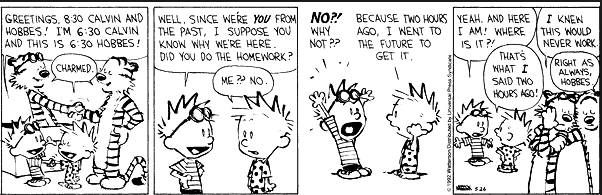
Unlike Calvin here, most of us will probably never get the opportunity to have a face-to-face conversation between our current selves and our 6:30 selves, so to speak. That is a shame, because as Daniel Kahneman discusses in Thinking, Fast and Slow , the two of them don't necessarily know that much about each other. In trying to understand how the brain registers emotion, Kahneman outlines the divide between what he calls the "experiencing self" and the "remembering self." The experiencing self, or "8:30 Calvin", if you will, is you in the present. All it knows is whether or not you are having a good time in the moment. The remembering self, or "6:30 Calvin", on the other hand, looks back and tries to to sum up your overall impressions of past events. Which Calvin holds more sway in your judgements?  That prize goes to 6:30 Calvin. It makes a certain amount of sense. The trouble with living "in the now" is that every second ...

Six Strategies for Avoiding the Truth

Image
Are you lying to yourself every day? Depends: are you a "Bayesian Updater?" Hopefully you are. The term is named after Reverend Thomas Bayes. Around 1763, Bayes proposed a probability theory which stated that when you're confronted with facts contradicting your current beliefs, you change or update your beliefs. In his new book, Answers for Aristotle , University of Chicago’s Massimo Pigliuuci suggests that if humans are rational, then the Bayesian principle should be our default. Of course, modern science has done a great deal to de-emphasize the role of logic in decision-making. Even the great philosopher Aristotle, upon closer reading, suggests we are more rationalizers than rational. So if people aren't Bayesian Updaters, what are they? In their study of cognitive dissonance, Northwestern University professor Monica Prasad and her research team have identified six alternative strategies. Their work shines light on just how intelligent and well informed ind...