Posts

Showing posts with the label the self

Consciousness: Signals in the Noise

Image
In February’s blog post, How your Brain is Like an Ant Colony , we discussed how neural networks follow the concept of emergence: when it comes to connections between neurons, much of the order arises by neurons organizing themselves, without top-down direction. Arne Dietrich, the author of How Creativity Happens in the Brain , writes that some of those networks are hardwired and some are flexible and built in the moment. What determines the strength and intensity of a neural network include “a person’s unique past experience, opinions, preferences, and expertise." He explains that, in the same way "lightning follows the path of least resistance," the strongest connections send the fastest signals, taking over brain regions in a phenomenon called "spreading activation." The lack of an overall leader makes ant colonies fascinating. But if our own thoughts (activated neural networks) are all just a matter of signal strength, what is the self? How does sel...

The Anatomy of Emotion

Image
What is fear made of? In his book Self Comes to Mind , Antonio Demasio describes emotions as complex, largely automated neural programs of action. He writes that emotions can be triggered by real-time events, events of the past, or images related to events. They tap into various brain regions, including the areas concerning language, movement, and reasoning. This in turn sets off a chain of chemical reactions. Certain kinds of emotions tend to activate specific brain regions, producing a kind of lock and key effect. For instance, situations involving fear unlock the amygdala and triggers additional chemicals associated with fear. Our perceptions of those internal changes are what we call feelings. (When two regions are affected at the same time, it can create a composite or mixed emotion, such as bittersweetness or nostalgia.) Feelings are the body’s readout of what’s happening internally, combined with your moment-by-moment state of mind. As Damasio says, “Feelings are the co...

How Your Brain is Like an Ant Colony

Image
Ants are amazing. They can carry 50 times their body weight. Their total biomass worldwide equals the total biomass of humans. Fungus ants started farming 50 million years before agriculture was even a glint in early human eyes. When it comes to teamwork, humans can't compare. There may be no "I" in team, but there are plenty of ants. Collectively, a colony of ants is capable of a variety of sophisticated actions—building intricate nests ( out of their own bodies if they're army ants ), fighting wars with other colonies, raising livestock , and yes, even raiding that picnic basket. All this despite the long-established fact that ants are just not that smart. It's not unusual to see two ants struggling to carry a crumb in opposite directions. Although the number varies from species to species, the average ant has something like 250,000 neurons. To be fair, that's more than double the neurons of a lobster (100,000), but even a humble cockroach puts it to ...

The Peak End Rule, or, The Secret to a Winning Colonoscopy

Image
When we consider ourselves as individuals, we tend to think in terms of a single entity with agency. In essence, I take on information through my five senses and then use my memories to inform, guide and, perhaps most importantly, predict what will happen next—or, more accurately, what might happen next. So those recollections, the stories we tell ourselves to record those experiences, are what fundamentally help us both understand ourselves and the world around us.  This all makes perfect sense, except for one problem: that’s not actually how it works, according to Daniel Kahneman, Nobel Prize-winning economist. Kahneman says the two systems—experiencing and remembering—are not in sync. In a series of experiments, he and his team proved that your experiencing self perceives the world moment by moment, but your remembering self follows a strange phenomena that Kahneman refers to as the “peak end rule.”  Here’s how it works: our remembering selves tend to re...

Zen and the Art of Riffing

Image
Q: What did the Zen master say to the hotdog vendor? A: “Make me one with everything...” Central to the premise of this old joke is the Zen notion of reaching a higher level of consciousness, where one’s sense of self dissipates, becoming indistinguishable from the rest of the universe. This is pretty heady stuff for many raised in the western thought tradition, where metrics are king, and we’re taught from a young age that if it can't be measured, it doesn't exist. So what do jazz players and Zen masters have in common? I’m sure there’s a pun in here somewhere, but the truth is, they may share a lot, according to Johns Hopkins neuroscientist Dr. Charles Limb. Around 2008, Limb began doing experiments with jazz pianists , trying to understand what was happening in their brains during musical improvisation. Limb had them improvise music while lying in an fMRI; the tool of choice for many neuroscientists. It’s a machine that measures blood flow to a given brain area...

The Experiencing Self, or, Why Present-You Hates Past-You

Image
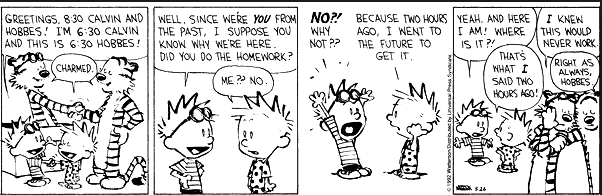
Unlike Calvin here, most of us will probably never get the opportunity to have a face-to-face conversation between our current selves and our 6:30 selves, so to speak. That is a shame, because as Daniel Kahneman discusses in Thinking, Fast and Slow , the two of them don't necessarily know that much about each other. In trying to understand how the brain registers emotion, Kahneman outlines the divide between what he calls the "experiencing self" and the "remembering self." The experiencing self, or "8:30 Calvin", if you will, is you in the present. All it knows is whether or not you are having a good time in the moment. The remembering self, or "6:30 Calvin", on the other hand, looks back and tries to to sum up your overall impressions of past events. Which Calvin holds more sway in your judgements?  That prize goes to 6:30 Calvin. It makes a certain amount of sense. The trouble with living "in the now" is that every second ...

The Science Behind Your Out of Body Experience

Image
What do epilepsy, an out of body experience and your personal space bubble share in common? Mother-and-son science writers Sandra and Matthew Blakeslee explain the connection in their book, The Body has a Mind of its Own. Team Blakeslee begin their story in an unlikely place: the region of your brain behind your right ear. It’s known as your Right Angular Gyrus (RAG). Before an epilepsy operation, the surgeon’s standard procedure is to open up the skull and poke around a little to identify the various functional brain areas. Even though human brains share the same essential architecture, each brain is wired slightly differently. A quick round of poking and prodding is the best way to get a sense of the layout, and thus to know what not to cut. Since the brain doesn’t feel pain, this recon mission is done with the patient awake. The surgeon probes a given area, and the patient reports back what they are feeling. For example, a gentle touch on one area of your brain m...

How Smart are You?

Image
How do we measure intelligence? The ancient Chinese had some of the first tests designed to evaluate a person's smarts: a game called tangram and another game called jiulianhuan . You can still play them today, if you're a fan of puzzles or humility. In 1905, Alfred Binet, Victor Henri and Theodore Simon needed a way to assess mental retardation in school children. They created their own system, the not-very-cleverly-named Binet-Simon test. This eventually morphed into the Intelligence Quotient test, more commonly known as the I.Q. test. It analyzes your applied knowledge of math, as well as verbal and spatial recognition skills. At the end of the test, you get a number between 1 and 200. This number tells us how smart you are, or so conventional wisdom went. Most of us hummed along happily with this notion until Howard Gardner showed up in 1983 with his ground-breaking book Frame of Mind . In his book, Gardner argued that the standard I.Q. test doesn't give u...

Sourdough, Websites, and the Self: The Myth of the Driver's Seat

Image
Our story this week begins around 1500 BC. It was roughly 3500 years ago that somehow––let’s be honest, probably through some kind of accident that doesn’t bear thinking about––Egyptians discovered that a mixture of flour and water, left in the right conditions, could bubble and ferment into a tangy ball of risen dough, and that this ball, when baked, was not only edible but delicious. In all likelihood, this was the beginning of leavened bread. Sourdough, as we call it today, harnesses yeast at its simplest, its most elemental. All the crucial microbes––the wild yeast and the lactic acid bacteria––already exist in the air around us, floating freely, just waiting for the chance to metabolize some glucose and release pockets of carbon dioxide. All you need for a good starter is flour, water, and a dream. (And the willingness to consume a lot of microscopic critters). This simplicity led to its appeal among cowboys and other assorted ramblers of the American West. Today in San Fra...