Posts

Sleeping on the Job

Image
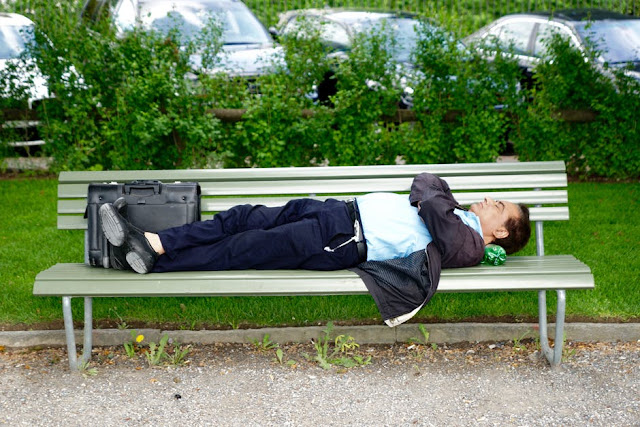
For most of us, the thought of getting caught sleeping at our desks is stressful enough to send our brains a zippy little wake-up shot of cortisol. For others, napping at work might bring to mind one of those hyper-trendy companies, the kind with yoga and juice bars, and an almost disturbing zeal to replace desk chairs with exercise balls, or treadmills, or kiddie pools filled with salt water and live tropical fish. (Give it time; it’ll happen.) And indeed, firms like Google, Ben & Jerry’s, PricewaterhouseCoopers, and Zappos have all invested in creating a space specifically for employees to close their eyes and take a mid-day snooze. In fact, according to a 2015 article on Inc.com , roughly 6% of employers now offer an onsite nap room of some sort. As with many trends in the U.S., we didn’t invent the nap break so much as we borrowed it from other cultures. In Spain, businesses famously close from 2 to 5 to accommodate a daily “siesta” for workers— although ironically, our ...
Nightmare Boss: The Dangers of Sleep-Deprived Leadership

Image
Let’s say you’re a sleep pro. You’ve learned the key role of REM cycles in encoding new memories, and the troubling statistics linking tired driving with automobile accidents. You’ve taken steps to log your 7 to 9 hours every night, and are enjoying the benefits of a healthier, more energetic you. But there is still a way that sleep-deprivation could be shaping—and harming—your day-to-day life. You may be sleeping enough. But what about your boss? What about your boss’s boss? After all, if it’s unwise to operate heavy machinery on a sleep debt, it’s surely a bad idea to operate an entire business, with millions of dollars—not to mention the careers of real-life human beings on the line. However, it seems to be all too common. In a recent survey of more than 180 business leaders, 43% reported getting insufficient sleep at least four nights a week . In other words, for four out of ten respondents at the top of the corporate ladder, those unrested nights are more common tha...

The Frequency Illusion: How Not to Fall for Argle-Bargle

Image
Let’s say you’re reading up on landmark Supreme Court decisions of the past decade. (Hey, everybody needs hobbies.) You’re skimming an article from 2013 about the abolition of DOMA, when you encounter a soundbite from the late Justice Scalia, dismissing his opponent’s arguments as “legalistic argle-bargle.” Hold on a minute. You blink at the page. “Argle-bargle”? Is that a typo? If so, what would it possibly be a typo for? You backtrack and discover, nope, that quote appears in multiple sources. Just what’s going on here? Had Justice Scalia taken leave of his senses? Your answer might depend on your political beliefs, but at least as far as this particular phrase goes, the man was not talking nonsense. As The Atlantic explained to its confused readers at the time , Antonin was simply using an old-fashioned Scottish word for “nonsense,” basically an across-the-pond equivalent to “mumbo-jumbo.” You absent-mindedly add a new word to your vocabulary, and continue on with your wor...

How the Decoy Effect Makes Dupes of Us All

Image
Imagine that, on the second morning of a business trip, you go to unzip your suitcase, only to realize you forgot to pack any pants. With just a few hours before a big presentation, you duck into the closest mall, for a shopping trip with a firm deadline. You step into a promising store, and with the help of a sales clerk, you quickly narrow the pool of potential pants to just two options. Pair A is stylish and flattering, but they’re pushing your emergency pants replacement budget at $70. Pair B won’t turn any heads, but they fit fine, and they’re on sale for $20. ‘Is it worth it to splurge on a pair of pants I’ll only need to wear once?’ you ask yourself, frowning in the dressing room mirror. ‘The cheaper ones will get the job done, and it’s not like I don’t have nice pants at home.’ Just then, the clerk knocks on the door. “Hey,” she says, “As long as you’re trying on slacks, we just got a new shipment in, and I think we’ve got your size.” She passes you a new pair of p...

The Problem(s) With Myers-Briggs in Business

Image
Imagine going to a corporate team-building event where everyone in your office was sorted and evaluated based on the results of taking one of those time-wasting Buzzfeed quizzes, like “Which Disney Character Would You Be Friends With?” or “ Which Muppet Are You? ” It might make for an interesting afternoon, or at least a weird story to tell the next time you’re at a party, but it probably wouldn’t leave you feeling like you had gained some crucial self-insight to help you function better at work or in your home life. Clicking through an online quiz might be a decent way to procrastinate, but in the back of our minds, we all know that Buzzfeed doesn’t employ a lab of white-coated psychologists to study, for instance, the deep-seated implications of preferring Cartoon Network to Nickelodeon. It may be fun, but we wouldn’t call it science . This brings us to the Myers-Briggs. You’ve probably heard of Myers-Briggs, or as it’s more formally known, the Myers-Briggs Type Indicator sur...

The Pygmalion Problem

Image
Just how much is your performance shaped by the way your boss talks to you? To what extent are our behaviors, attitudes, and identities simply a reflection of somebody else’s expectations? This been the subject of controversy since at least 1968, when Robert Rosenthal and Lenore Jackson published their book Pygmalion in the Classroom . In it, Rosenthal and Jackson described studies in which first and second grade teachers seemed to treat students differently based on how smart they believed each child to be, which in turn had a direct impact on that child’s actual performance. This held true even when researchers lied to the teachers about the children’s intelligence—children who were labeled as gifted were treated as such and still performed as such, independently from their actual IQs. The following year, J. Sterling Livingston wrote his now-legendary article for the Harvard Business Review , “Pygmalion in Management.” Citing several studies, Livingston asserted that the...

Fallen Empires and Phony Wine: The Seersucker Effect

Image
Making iffy predictions about our future: it’s been a hallmark of human behavior for at least as long as we’ve been recording our present. Perhaps the most famous early example of forecasting took place in Mount Parnassus in Delphi, Greece. From roughly the 8th century BCE to the 4th century BCE, for nine days each year, travelers could pay to pose their burning questions to the Pythia, a priestess said to channel the wisdom of Apollo. To a modern reader, perhaps a bit skeptical about the whole Greek gods thing, it may be unsurprising to learn that the Pythia phrased her answers as riddles, arguably granting her some convenient wiggle room. For instance, as the story goes, King Croesus once asked a Pythia if he should attack the neighboring Persian Empire. "Cross the border and a great empire will fall,” she told him. Encouraged, Croesus brought his troops over the border—and suffered a crushing defeat. Her reaction was to coolly point out that he had failed to make her s...